
2026 County Loan Limits for Conventional, FHA, VA, and USDA Home Financing
What Are the 2026 County Loan Limits?
The 2026 baseline conforming loan limit is $832,750 for a one-unit property in most U.S. counties, rising to $1,249,125 in high-cost counties. FHA county limits run from a $541,288 floor to a $1,249,125 ceiling. VA loans have no county limit for veterans with full entitlement, and USDA loans do not use county loan limits at all, relying on household income and property location instead. Above the conforming limit, a loan becomes jumbo, or non-conforming. Nationwide Home Loans Group writes jumbo purchase and refinance financing up to $10 million and construction financing up to $4.5 million. Use the county lookup below to find the exact 2026 limit for your county.
Our lending professionals have originated mortgages across every loan program type for borrowers in all 50 states. Whether you need conventional financing, government-backed options through FHA or VA, rural property loans, construction funding, renovation capital, or refinancing, we guide clients through the full spectrum of mortgage programs available in today's market.
How the 2026 Conforming Loan Limits Affect Your Mortgage Options
The Federal Housing Finance Agency published updated conforming loan limit figures on November 25, 2025, establishing the maximum mortgage amounts that Fannie Mae and Freddie Mac can purchase for the coming year. These thresholds take effect January 1, 2026 and directly influence what financing options are available to you.
For 2026, the national baseline conforming limit increases to $832,750 for a single-family residence. This represents a $26,250 bump from the 2025 figure of $806,500, driven by a 3.26% rise in average home prices according to FHFA's House Price Index data. In counties where median home values push past certain thresholds, limits climb higher, reaching a maximum ceiling of $1,249,125 for one-unit properties.
Why do these numbers matter? Mortgages that stay within conforming limits typically qualify for better interest rates and smoother approval processes compared to jumbo loans, which exceed these caps and often require larger down payments, higher credit scores, and more documentation. Knowing your county's specific limit helps you understand what financing tier your purchase or refinance falls into and which loan programs make sense for your situation.
The sections below break down how these limits apply across conventional, FHA, VA, and USDA programs, along with what to do when your financing needs extend beyond standard thresholds.
Find Your 2026 County Loan Limit
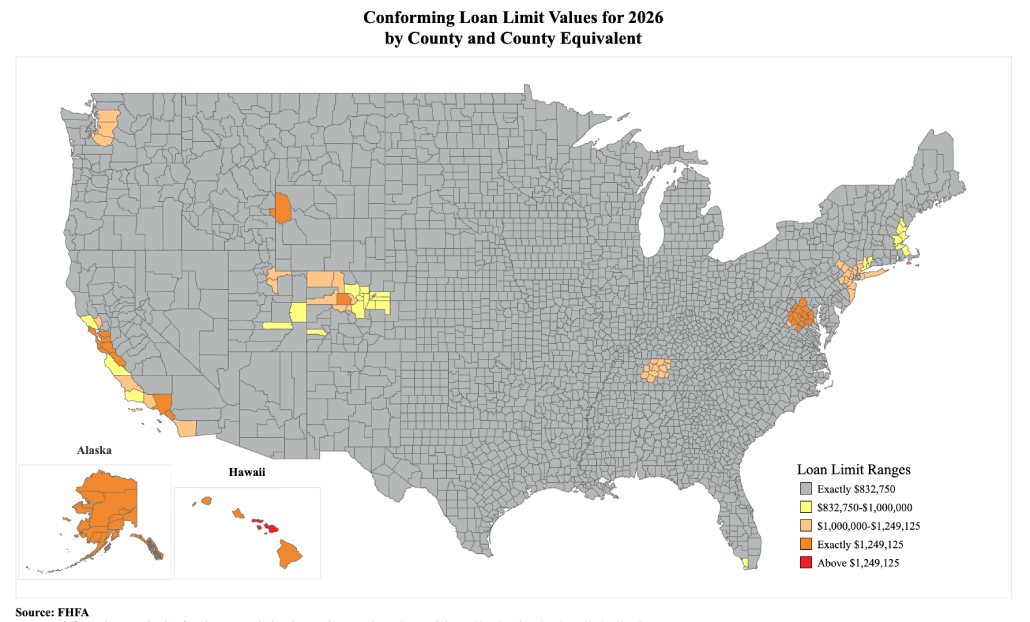
Source: Federal Housing Finance Agency, 2026 Conforming Loan Limit Values, effective January 1, 2026. Figures shown are conforming, or conventional, limits for loans eligible for purchase by Fannie Mae and Freddie Mac. Review the full county set on the FHFA conforming loan limit page, or look up your exact FHA county limit with HUD's FHA mortgage limits tool. FHA and VA programs use separate rules described below.
2026 High-Cost Counties Above the $832,750 Baseline
| County | 1 Unit | 2 Units | 3 Units | 4 Units |
|---|
What Your County Limit Means for You
If your loan is under the county limit
Over 3,000 counties use the baseline limit, so this is where most people land. Staying inside your county's conforming limit is the better position to be in:
- Conforming loans generally carry lower interest rates than jumbo financing
- Down payment and credit requirements are more flexible
- Every program stays open to you: Conventional, FHA, VA, USDA, construction, and renovation
- Underwriting is usually faster with less documentation
Worth saying plainly: qualifying for the maximum does not mean you should borrow it. The limit is a ceiling, not a target, and a payment you are comfortable with matters more than the largest number a lender will approve.
Compare purchase, refinance, construction, and renovation programs at BuildBuyRefi, our full loan guide library.
If your loan is above the county limit
Once you pass your county's conforming threshold, you are in jumbo, or non-conforming, territory. That usually means higher credit score minimums, larger down payments, and more documentation.
It does not mean no. We write jumbo purchase and refinance financing up to $10 million and construction financing up to $4.5 million, with in-house underwriting and our own loan committee for exceptions.
VA-eligible borrowers with full entitlement have no county loan limit at all, so a loan that would be jumbo for someone else may not be jumbo for you.
You have your county limit. Now find out what you qualify for.
2 minutes, zero credit impact to see your options. Or call and talk to a real person, 24 hours a day, 7 days a week. No robots, no phone trees.
2026 Conventional Conforming Loan Limits By County
Conventional mortgages backed by Fannie Mae and Freddie Mac follow the limits established by FHFA. These figures determine whether your loan qualifies as "conforming" (eligible for purchase by the government-sponsored enterprises) or "non-conforming" (requiring alternative financing structures).
Baseline Limits (Majority of U.S. Counties)
Over 3,000 counties across the United States use these standard baseline figures for 2026:
| Property Units | 2026 Baseline Limit |
|---|---|
| 1 Unit | $832,750 |
| 2 Units | $1,066,250 |
| 3 Units | $1,288,800 |
| 4 Units | $1,601,750 |
If you're purchasing a primary residence, second home, or investment property in most parts of the country, these baseline figures represent your conforming loan ceiling.
High-Cost Area Ceiling Limits
Roughly 155 counties qualify for elevated limits because their median home values exceed 115% of the national baseline. The FHFA caps these high-cost area limits at 150% of the baseline:
| Property Units | 2026 High-Cost Ceiling |
|---|---|
| 1 Unit | $1,249,125 |
| 2 Units | $1,599,375 |
| 3 Units | $1,933,200 |
| 4 Units | $2,402,625 |
Counties in metropolitan areas like San Francisco, New York City, Los Angeles, Seattle, and Washington D.C. typically sit at or near this ceiling. Many counties fall somewhere between baseline and ceiling based on their local median values. You can look up your specific county's limit through the FHFA Conforming Loan Limit lookup tool.
Alaska, Hawaii, Guam, and U.S. Virgin Islands
Federal statute grants these locations elevated baseline limits, recognizing the higher costs of construction and living. The baseline in these areas starts at 150% of the national baseline, with a ceiling reaching 150% of that elevated figure:
| Property Units | 2026 Baseline | 2026 Ceiling |
|---|---|---|
| 1 Unit | $1,249,125 | $1,873,675 |
| 2 Units | $1,599,375 | $2,399,050 |
| 3 Units | $1,933,200 | $2,899,800 |
| 4 Units | $2,402,625 | $3,603,925 |
2026 FHA Loan Limits By County
FHA mortgages follow a related but distinct limit structure. The Department of Housing and Urban Development calculates FHA limits as percentages of the FHFA conforming figures: the floor sits at 65% of the conforming baseline, while the ceiling matches the conforming high-cost maximum.
FHA Floor Limits (Low-Cost Markets)
In areas where median home values fall below national averages, FHA limits default to the floor:
| Property Units | 2026 FHA Floor |
|---|---|
| 1 Unit | $541,288 |
| 2 Units | $693,063 |
| 3 Units | $837,720 |
| 4 Units | $1,041,138 |
FHA Ceiling Limits (High-Cost Markets)
In expensive markets, FHA limits can reach the same ceiling as conventional high-cost limits:
| Property Units | 2026 FHA Ceiling |
|---|---|
| 1 Unit | $1,249,125 |
| 2 Units | $1,599,375 |
| 3 Units | $1,933,200 |
| 4 Units | $2,402,625 |
Most counties land somewhere between floor and ceiling, with specific FHA limits calculated based on local median values. FHA financing appeals to first-time buyers and borrowers who benefit from lower down payment requirements and more accommodating credit standards than conventional programs demand.
FHA Limits for Special Statutory Areas
Alaska, Hawaii, Guam, and the U.S. Virgin Islands receive even higher FHA limits:
| Property Units | 2026 FHA Special Area Limit |
|---|---|
| 1 Unit | $1,873,688 |
| 2 Units | $2,399,063 |
| 3 Units | $2,899,800 |
| 4 Units | $3,603,938 |
2026 VA Loan Limits by County
Since the Blue Water Navy Vietnam Veterans Act took effect January 1, 2020, VA home loans no longer impose a county loan limit for veterans with full entitlement. If you have never used your VA benefit, or you have fully restored it after selling a property and paying off the associated VA loan, you can finance above any county limit with zero down payment, subject to meeting lender qualification standards.
County conforming limits still matter for veterans with partial entitlement, meaning those with an existing VA loan, a prior foreclosure that affected entitlement, or some portion of the benefit otherwise tied up. In those situations the FHFA county limit factors into calculating available guaranty coverage, which can require a down payment on amounts above remaining entitlement.
Use the county lookup above to find the conforming limit where you are buying. For VA purchase, construction, renovation, and refinance programs, our specialists at VA Nationwide work exclusively with veterans and military families.
2026 USDA Loan Limits by County
USDA Rural Development loans do not use county loan limits the way conventional and FHA financing does. There is no county purchase price cap tied to the conforming limits on this page.
USDA eligibility rests on three things instead: household income, generally capped at 115% of area median income for your county, debt-to-income ratios, and whether the property sits inside a USDA-designated rural area. USDA does reference area loan limits for certain internal calculations, but the binding constraints are income and geography rather than a published county maximum.
That distinction trips up a lot of borrowers who assume USDA works like FHA. If you are looking at rural or suburban property, our team at USDA Nationwide can confirm both the income limit and the property eligibility for your specific county.
Financing Options for Manufactured, Modular, and System-Built Homes
Factory-built housing, including manufactured homes, modular construction, and alternative building methods like SIP panels, metal frame structures, barndominiums, and ICF construction, follows the same conforming loan limits as traditional site-built properties when financed through conventional programs.
The key distinctions lie not in the limits themselves but in specific eligibility requirements: HUD certification for manufactured homes built after June 15, 1976, permanent foundation requirements, age restrictions (often 15-20 years maximum), and proper land ownership or lease arrangements.
FHA Title II loans for manufactured homes classified as real property use the same FHA floor and ceiling limits described above. FHA Title I loans, which cover chattel financing and certain combination loans, operate under separate HUD-established limits.
For buyers navigating the specific requirements of factory-built home financing, Manufactured Nationwide provides specialized expertise in these programs.
Historical Conforming Loan Limit Trends (2021-2026)
Tracking how limits have evolved provides perspective on housing market trajectory and helps borrowers understand shifts in purchasing power over time.
| Year | 1-Unit Baseline | 1-Unit High-Cost Ceiling | Year-Over-Year Change |
|---|---|---|---|
| 2021 | $548,250 | $822,375 | +7.42% |
| 2022 | $647,200 | $970,800 | +18.05% |
| 2023 | $726,200 | $1,089,300 | +12.21% |
| 2024 | $766,550 | $1,149,825 | +5.56% |
| 2025 | $806,500 | $1,209,750 | +5.21% |
| 2026 | $832,750 | $1,249,125 | +3.26% |
The 3.26% increase for 2026 marks the slowest annual growth since limits began climbing again after the 2008 housing correction. This moderation reflects stabilizing home price appreciation according to FHFA's third-quarter House Price Index data.
Multi-Unit Baseline Progression (2024-2026)
| Year | 1 Unit | 2 Units | 3 Units | 4 Units |
|---|---|---|---|---|
| 2024 | $766,550 | $981,500 | $1,186,350 | $1,474,400 |
| 2025 | $806,500 | $1,033,000 | $1,248,150 | $1,551,250 |
| 2026 | $832,750 | $1,066,250 | $1,288,800 | $1,601,750 |
Investors considering multi-unit properties can use rental income from non-owner-occupied units to help qualify, making duplexes, triplexes, and fourplexes attractive wealth-building vehicles within conforming loan parameters.
What Happens When Your Loan Exceeds the Limit
When your financing needs surpass your county's conforming threshold, you enter jumbo loan territory. Jumbo mortgages, also called non-conforming loans, typically involve stricter qualification criteria: higher credit score minimums, larger down payment requirements, more extensive income documentation, and potentially higher interest rates depending on market conditions.
Nationwide Home Loans Group offers non-conforming and in-house portfolio solutions well beyond conforming limits, with jumbo purchase and refinance financing up to $10 million and construction financing up to $4.5 million. We also provide one-time close, two-time close, and Hybrid construction loans that accommodate both conforming and jumbo scenarios, combining construction and permanent financing into a single loan with one closing.
If your purchase price or refinance amount exceeds standard limits, our team can evaluate whether jumbo financing, portfolio lending, or an alternative structure makes the most sense for your circumstances.
Above your county limit? That is the loan we are built for.
Jumbo purchase and refinance to $10 million, construction to $4.5 million, with our own loan committee for exceptions. 2 minutes, zero credit impact to see your options.
Common Questions
2026 County Loan Limit Questions, Answered
What is the 2026 conforming loan limit?
The 2026 baseline conforming loan limit is $832,750 for a one-unit property in most U.S. counties, a 3.26% increase of $26,250 over the 2025 limit of $806,500. High-cost counties reach $1,249,125. Alaska, Hawaii, Guam, and the U.S. Virgin Islands start at $1,249,125 with ceilings up to $1,873,675.
How do I find my county's specific limit?
Use the county lookup tool at the top of this page. Select your state and county and you will see the 2026 conforming limit for one through four units, along with whether your county is baseline or high-cost. The FHFA also publishes a full searchable database each November.
How are county loan limits calculated?
FHFA sets county limits using local median home values within metropolitan or micropolitan statistical areas. When 115% of the highest median home value in a county's statistical area exceeds the national baseline, that county qualifies for an elevated limit, capped at 150% of the baseline.
What is the difference between conforming and FHA limits?
Conforming limits apply to conventional loans purchased by Fannie Mae and Freddie Mac. FHA limits, set by HUD, are calculated from them: the floor is 65% of the conforming baseline, or $541,288 for 2026, and the ceiling matches the conforming high-cost maximum of $1,249,125. Your county's FHA limit falls somewhere between based on local median values.
Do VA loans follow these limits?
For veterans with full entitlement, VA loans have had no maximum since January 2020. Qualified veterans can purchase above any county limit with zero down payment. Veterans with partial entitlement still reference county limits when calculating available guaranty coverage, which can affect down payment on higher-priced properties.
How do USDA loan limits work?
USDA Rural Development loans do not use county loan caps the way conventional and FHA financing does. Eligibility depends on household income, generally 115% of area median income or below, debt-to-income ratios, and whether the property sits in a USDA-designated rural area. The conforming limits on this page do not constrain USDA financing.
Do these limits apply to construction loans?
Yes, when the permanent financing will be a conforming mortgage, the total loan amount must fall within your county's limit. That applies to one-time close, two-time close, and our Hybrid construction loans alike. Projects above the limit move to jumbo construction financing, which we write up to $4.5 million.
What are jumbo loans?
Jumbo loans, also called non-conforming loans, exceed the conforming limit for a given county. Because Fannie Mae and Freddie Mac cannot purchase them, they typically require stronger credit, larger down payments, and more documentation. We write jumbo purchase and refinance financing up to $10 million with in-house underwriting.
When do the 2026 limits become effective?
January 1, 2026. Loans delivered to Fannie Mae or Freddie Mac on or after that date follow the new limits. Loans closing in late December 2025 typically fall under 2025 limits unless delivery occurs in the new year.
Do loan limits affect refinancing?
Yes. Your new loan amount must fall within current conforming limits to qualify as conforming. If your existing balance plus any cash-out exceeds your county's 2026 limit, you would need jumbo refinancing. The higher 2026 limits may also let some borrowers with previous jumbo loans refinance into conforming products.
Can conforming loan limits ever decrease?
No. Under the Housing and Economic Recovery Act of 2008, conforming loan limits cannot decrease. If home prices decline, limits stay flat until appreciation exceeds previous peaks. This applies at both national and county levels.
Why did limits increase less in 2026 than in previous years?
The 3.26% increase reflects moderating home price growth in FHFA's House Price Index. After 18.05% in 2022, 12.21% in 2023, 5.56% in 2024, and 5.21% in 2025, the slower pace indicates a stabilizing housing market rather than the rapid appreciation of recent years.
Connect With Our Lending Team
Understanding loan limits is the starting point for mapping out your mortgage strategy. The right financing structure depends on far more than just these thresholds: your income, credit profile, down payment resources, property type, and long-term goals all factor into which program delivers the best outcome.
Nationwide Home Loans Group brings together expertise across conventional, FHA, VA, and USDA programs, plus construction financing, renovation loans, refinancing options, and non-conforming solutions for borrowers whose needs extend beyond standard limits. Our lending team has guided borrowers through every market condition and property scenario imaginable.
Ready to explore your options? Call us at 844-999-0639, start a chat conversation, or check your eligibility online in about two minutes with no credit pull. We'll help you understand exactly how your county's limits affect your plans and which financing path makes the most sense for you.





Sources and Official References
The loan limit figures on this page are sourced from official government publications:
Federal Housing Finance Agency (FHFA), "Conforming Loan Limit Values for 2026," published November 25, 2025. Available at fhfa.gov/CLL
FHFA 2026 Conforming Loan Limit Addendum (calculation methodology)
FHFA Conforming Loan Limit FAQs
FHA loan limits are calculated based on HUD guidelines using 65% of the conforming baseline for floors and 150% for ceilings. Official FHA limits are published by the Department of Housing and Urban Development.
Disclaimer: The figures on this page reflect FHFA's November 2025 announcement for 2026 conforming loan limits. Specific county limits and program details may vary. Always verify current guidelines with a loan officer, as program rules and lender requirements can change.
About Nationwide Home Loans Group
Nationwide Home Loans Group, powered by The Federal Savings Bank (NMLS# 411500), provides mortgage financing across all major loan programs for borrowers in all 50 states. Our team originates conventional, FHA, VA, and USDA loans, along with construction financing, renovation programs, refinancing, HELOCs, and non-conforming solutions for specialized borrower needs.
We maintain an A+ rating with the Better Business Bureau and have earned recognition from industry publications for our expertise in construction lending and specialized mortgage programs. Our loan officers hold individual NMLS licenses and complete ongoing education to stay current with program guidelines and regulatory requirements.